

By Collins Odigie Ojiehanor
According to World Health Organization (WHO), exposure to high levels of air pollution can cause various health outcomes. Increased health risks, such as respiratory infections, heart disease, stroke, and lung cancer, can severely affect people who are already ill, such as children, the elderly, and poor people. Furthermore, poor air quality increases the risk of stillbirth, miscarriage, and neurological conditions such as cognitive impairment and dementia.
Lagos, one of Africa’s fastest-growing megacities, is facing a severe air pollution crisis. With a population of about 21 million, the city’s rapid urbanization and industrialization have led to a significant increase in air pollutants, posing a major threat to public health and the environment.
Vehicular Emissions and Industrial Activities
Vehicular emissions stand as one of the most significant sources of air pollution in Lagos. The city’s traffic congestion is notorious, with countless cars, buses, and motorcycles releasing a cocktail of pollutants such as nitrogen dioxide (NO2), carbon monoxide (CO), and particulate matter (PM) into the atmosphere.
The aged and poorly maintained fleet of vehicles exacerbates the situation, as they tend to emit higher levels of harmful substances compared to newer models with better emission control technologies.
Industrial activities also contribute significantly to the air pollution problem in Lagos. The city hosts numerous factories and manufacturing plants, many of which operate with minimal environmental oversight.
These industrial facilities emit a range of pollutants, including sulfur dioxide (SO2), volatile organic compounds (VOCs), and heavy metals, which deteriorate air quality and pose severe health risks to nearby communities.
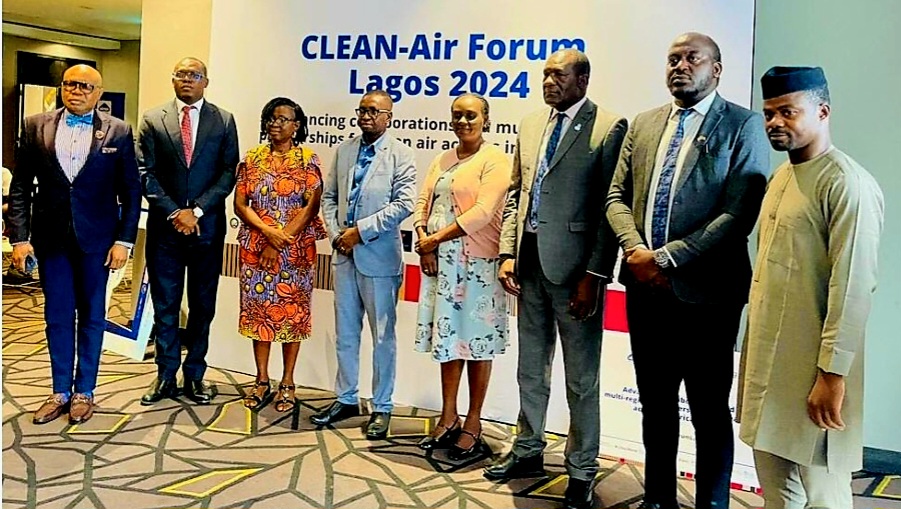
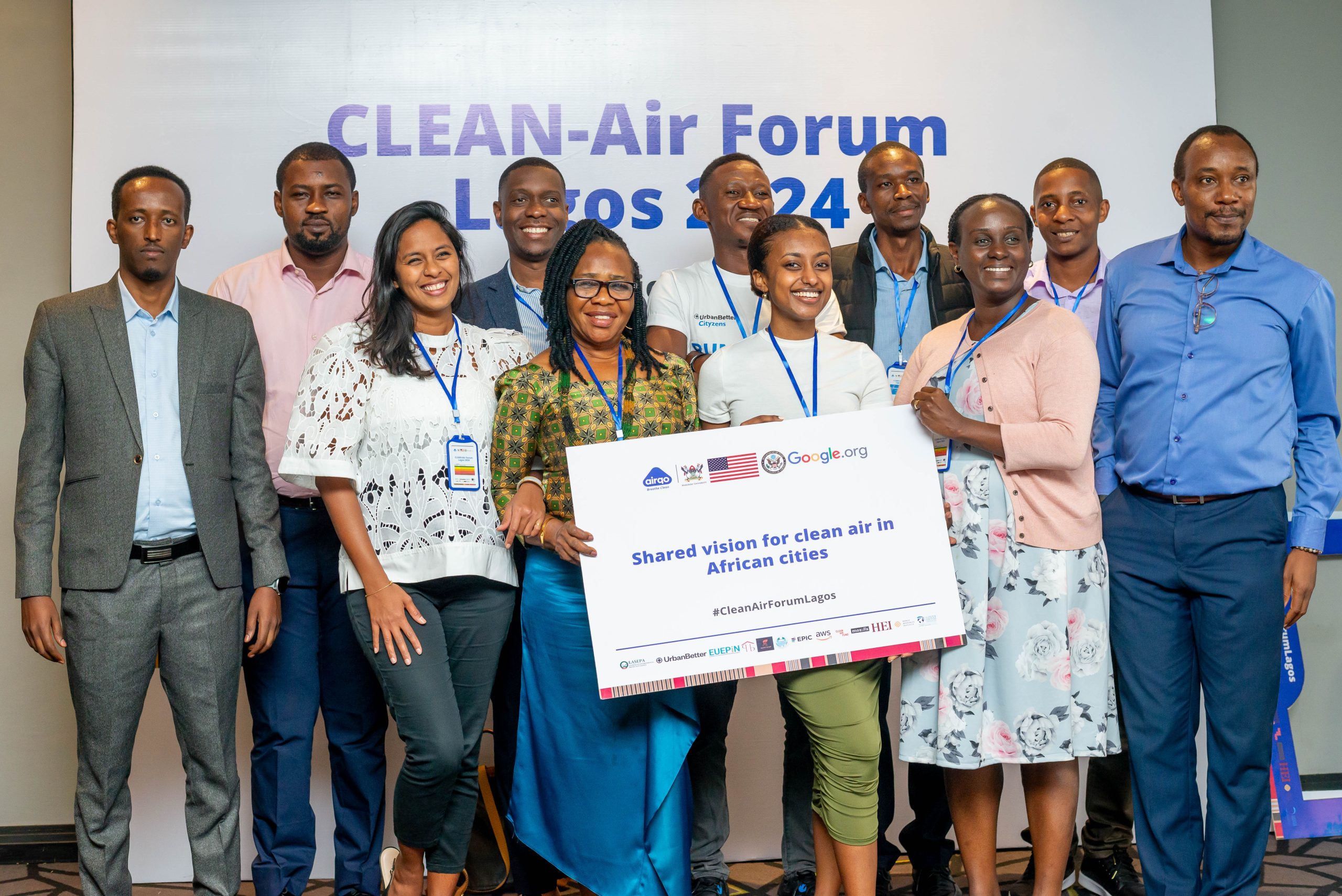
(L to R) Prof. Abraham Osinubi, Dean PG School, University of Lagos, Dr. Babatunde Ajayi, LASEPA General Manager, Selina Amoah, Ghana Environmental Protection Agency (Ghana EPA), Engineer Bainomugisha AirQo Lead, Martha Mugarura, Ministry of Lands, Kampala, Uganda, Abala Wanga City Manager, Kisumu City County, Albert Aheebwa Speaker, FortPortal, Dr. Oluwadare Kehinde, General Manager, Ogun State EPA.PC: AirQo.
Open Burning of Waste and Domestic Cooking Practices
The open burning of waste is a common practice in Lagos due to inadequate waste management infrastructure. Residents often resort to burning trash in open spaces, releasing toxic fumes and particulate matter into the air.
This practice not only contributes to air pollution but also exacerbates respiratory problems among the population. This practice not only contributes to air pollution but also exacerbates respiratory problems among the population.
Many households in Lagos still rely on traditional biomass fuels like wood, charcoal, and kerosene for cooking. The use of these fuels generates significant amounts of indoor air pollutants, including fine particulate matter and carbon monoxide, which can cause respiratory illnesses, especially in poorly ventilated homes.
Air Quality Management: A Collective Responsibility
Air quality management in Africa has raised public health and environmental concern, as the continent struggles with the challenges of rapid urbanization and industrialization. With its cities expanding at an unprecedented pace and industrial activities intensifying, Africa faces a critical juncture where the need for sustainable development must be balanced with the imperative of safeguarding air quality.
Across the continent, air pollution levels are rising alarmingly, posing significant health risks to millions of residents. Particulate matter, nitrogen dioxide, sulfur dioxide, carbon monoxide, and ozone are among the chief pollutants that are increasingly being detected in urban and peri-urban areas.
These pollutants, emanating from diverse sources such as vehicular emissions, industrial discharges, open burning of waste, and even domestic cooking practices, contribute to a toxic atmospheric cocktail that threatens the respiratory health of the population and exacerbates climate change.
The health impacts of poor air quality are profound, with respiratory illnesses, cardiovascular diseases, and premature deaths on the rise in polluted urban centers. Vulnerable populations, including children and the elderly, are particularly at risk.

As Africa continues to grow and develop, the quest for cleaner air represents a vital component of its journey towards sustainable development, ensuring that progress does not come at the expense of public health and environmental integrity.
The State of Global Air 2024 reports show that air pollution accounted for 8.1 million deaths globally in 2021, becoming the second leading risk factor for death, including for children under five years. Of the total deaths, noncommunicable diseases, including heart disease, stroke, diabetes, lung cancer, and chronic obstructive pulmonary disease (COPD), account for nearly 90% of the disease burden from air pollution.
More than 700,000 deaths in children under 5 years were linked to air pollution; this represents 15% of all global deaths in children under five. In some countries in Africa and Asia, nearly 1 in every 3 lower respiratory infection deaths in children under 5 is linked to air pollution.
 The State of Global Air 2024 report. Source: Health Effects Institute
However, efforts to manage air quality in Africa are gaining momentum, driven by a growing recognition of the need to protect both public health and the environment. Governments and non-governmental organizations across the continent are taking steps to establish comprehensive air quality monitoring networks, leveraging both ground-based stations and advanced satellite technology to collect real-time data on pollutant levels.
In a significant stride towards this goal, the AirQo (CLEAN-Air Network), a pan-African research initiative from Makerere University in Kampala, Uganda, in partnership with the Lagos State Environmental Protection Agency (LASEPA) held a capacity building training to enhance the capacity of policymakers, civil society organizations, scientists, journalists, amongst others, in effectively managing and reporting air quality issues across Africa, on Monday at the Radisson Blu Hotel in Ikeja, Lagos.
According to AirQo, the capacity building training with the theme “Advancing collaborations and multi-regional partnerships for clean air actions in African cities” is part of a 5-day engagement dialogue at the Lagos CLEAN-Air Forum 2024 aimed at building stakeholders synergies for sustainable air quality management in African cities, as well as building a community of practice for air quality management in Africa.
AirQo shared that the Lagos Forum follows the success of the inaugural workshop held in Kampala in 2023, which brought together participants and stakeholders from over 31 cities across the world. The meeting served as a launchpad for the CLEAN-Air Network, aimed at enhancing regional collaborations for air quality management.
Hosted by the Air Quality Monitoring Research Group (AQMRG), the Evidence Use in Environmental Policymaking in Nigeria (EUEPiN) from the University of Lagos, and other stakeholders, the 2024 edition of the CLEAN-Air Forum brings together communities of practice in Africa to promote knowledge sharing, collaborations, and multi-regional partnerships while particularly emphasizing the need to strengthen regional networks for sustained interventions.
In her opening remarks at the Journalist-scientist dialogue, Prof. Melina Platas, from the New York University, Abu Dhabi, emphasized that conversation around air pollution is very important; there is need for Air Quality Management and Reporting, to bring adequate information to the audience, relate critical issues and how it can be effectively addressed.

A cross section of experts and journalists at the Journalist-Scientists Dialogue on Air Quality Management, during the Clean Air Forum, at the Radisson Blu Hotel Ikeja, Lagos.PC: AirQo
Globally, more than 99% of the population live in areas where the air pollution is above WHO air quality guidelines and 4.2 million deaths are attributed to ambient air pollution each year. Around 2.4 billion people cook and heat their homes with polluting fuels and every year 3.2 million people die prematurely from household air pollution.
In 2019, air pollution caused about 6.7 million deaths. Of these, almost 85% are attributable to noncommunicable diseases (NCDs), including ischemic heart disease, stroke, lung cancer, asthma, chronic obstructive pulmonary disease (COPD), and diabetes. This makes air pollution the second leading cause of NCDs globally after tobacco, according to WHO report on Air quality, energy and health.
Initiatives Towards Tackling The Problem of Air Pollution in Lagos
The General Manager of LASEPA, Dr. Tunde Ajayi, speaking on initiatives towards tackling the problem of air pollution in Lagos highlighted that the state is making significant strides in improving indoor air quality in Lagos. Switching to clean energy for cooking and providing free gas through recycling initiatives, enforcing smoking laws indoors to reduce air pollution and protect public health.
In his words, he said “As far as indoor air quality monitoring or ambient monitoring, what we’ve done so far in Lagos is to make sure that we sort of change the kind of way people cook. So conversion to clean energy, and then replace trash for gas”
“So we collect plastic waste, give them cooking gas, and try to use very cheap alternatives. So I’m currently on a research with one of the foreign universities for a cleaner cooking gas method. And the gas is given for free. The agency gives gas out for free, and we’re able to do that” he explained.
“On the other hand, we are going really strong with our smoking law. Indoor smoking is also a thing, particularly around people who don’t want to smoke, and in spaces where people go for recreation and for relaxation. So we are going really hard on people, for indoor smoking. And I think that will help a great deal in reducing pollution at that level,” he added.

Despite Efforts, Challenge Lingers
Despite significant initiatives to improve indoor air quality, air pollution remains a critical challenge in Lagos. Lagos is one of the fastest-growing cities in Africa, this rapid urbanization leads to increased demand for transportation, housing, and energy, all of which contribute to air pollution.
The influx of people into the city has led to overcrowded neighbourhoods, where infrastructure struggles to keep pace with the growing population. Lagos suffers from severe traffic congestion, with millions of vehicles on the roads daily. Older, poorly maintained vehicles are common, emitting higher levels of pollutants. Public transportation options are limited, forcing many residents to rely on private cars and motorcycles, exacerbating emissions.
Factories and manufacturing plants often operate without stringent environmental controls, releasing harmful pollutants into the atmosphere. Industrial areas are frequently located near residential neighbourhoods, exposing residents to higher levels of pollution.
Notwithstanding LASEPA’s initiatives to provide cleaner cooking alternatives, many households continue to rely on traditional biomass fuels like wood and charcoal due to their availability and low cost. These cooking practices generate significant indoor air pollution, affecting the health of residents, especially in poorly ventilated homes.
Many residents live in poverty, making it difficult for them to adopt cleaner technologies and practices. The cost of switching to clean energy sources, even when subsidized, can be prohibitive for low-income families. Economic challenges also limit the government’s ability to invest in comprehensive air quality management infrastructure and enforcement mechanisms.

(L to R) Dr. Babatunde Ajayi, LASEPA General Manager, Selina Amoah, Ghana Environmental Protection Agency (Ghana EPA), Lemesa Hirpe Wari, Ethiopian Environmental Protection Authority, Maurice Kavai, Nairobi City County Government and Dr. Meelan Thondoo, University of Cambridge during a panel discussion at Radison Blue Hotel, Ikeja, Lagos, Nigeria. July 8th 2024. PC: AirQo.
In a latest report by WHO, finds that the world remains off course to achieve the Sustainable Development Goal (SDG) 7 which is about ensuring access to clean and affordable energy, efforts remain insufficient to reach universal access to clean cooking by 2030.
2.1 billion people still live without access to clean cooking fuels and technologies, with the number remaining largely flat last year. This carries with it huge implications for health, gender equality, and the environment, contributing to 3.2 million premature deaths each year.
Public and Stakeholders Engagement
Engaging the public and stakeholders in air quality management is crucial for addressing the persistent problem of air pollution in Lagos. Dr. Bolajoko Malomo, a social researcher and lecturer at the Department of Psychology, University of Lagos, emphasized the significance of such engagements, noting that Nigeria’s fast-growing population exacerbates the need to understand and protect the quality of air—a shared resource essential for life.
“Air pollution is inherently a social problem,” Dr. Malomo stated, “because it affects everyone who breathes the air.” She highlighted that, according to a World Health Organization (WHO) study, approximately 4.2 million people die prematurely each year from diseases caused by ambient air pollution. These diseases include heart disease, cancer, and respiratory illnesses, which collectively underscore the severe public health impact of poor air quality.
“The air we breathe is a shared resource; there is a need to engage and protect it,” Dr. Malomo continued. She stressed that human activities, from industrial emissions to vehicular pollution and waste burning, significantly contribute to air quality degradation. Addressing these activities through targeted interventions and public awareness is essential.

Dr. Bolajoko Malomo, a social researcher and lecturer at the Department of Psychology, University of Lagos.PC: AirQo
Dr. Malomo advocated for leveraging education and community engagement as pivotal strategies in combating air pollution. “There is a need to educate people on pro-environmental protection programs,” she said. “By raising awareness about the sources and effects of air pollution, communities can adopt more sustainable practices and support initiatives aimed at improving air quality.”
She also emphasized the importance of participatory programs that involve various stakeholders, including local communities, government agencies, and non-governmental organizations. These programs can facilitate the sharing of knowledge and resources, fostering a collaborative approach to air quality management.
Furthermore, Dr. Malomo pointed out the necessity of integrating air quality education into school curricula and community outreach programs. By instilling environmental consciousness from a young age and continuously engaging the broader public, Lagos can build a more informed and proactive population ready to tackle the challenges of air pollution.
Africa Must Stand Up for Itself
Air pollution in Africa is a pervasive and pressing issue, affecting every individual regardless of their socioeconomic status. Bimbo Oshobe, the president of the Slum and Informal Settlement Federation, Lagos, emphasized this on the nature and extent of air pollution in the Lagos.
Oshobe highlighted that air pollution is not a challenge faced by a single person but a collective problem that impacts everyone. “Every day, our activities bring us face-to-face with the reality of unclean air,” Oshobe explained.
“It’s not just the poor who suffer; whether you’re rich, poor, or physically challenged, the air quality affects us all. For instance, you might get exposed to smoke from a neighbour using firewood for cooking or from small generators commonly referred to as ‘I better pass my neighbour.’ These generators, while providing necessary electricity, emit harmful smoke and noise, contributing significantly to air pollution.”
Oshobe pointed out the daily encounters with air pollution that people often overlook. “Think about the smoke from generators; we’ve seen cases where this smoke has tragically killed families.
These stories come from various areas, yet many people remain unconcerned because they feel it hasn’t affected them personally. But every time you step outside, whether at a bus stop or near a street vendor, you’re breathing in this unclean air.”
The challenge extends beyond the streets into communities where residents interact daily. “We need to educate our community members,” Oshobe stressed. “It’s not just about the pollution you face on the streets, but also the air quality within our neighbourhoods”
“How do we communicate to people that they need to seek cleaner air solutions? For instance, I once spoke to a woman who couldn’t afford firewood or charcoal and was using plastic waste to cook. I explained to her that while this might seem like a quick solution, it’s causing severe health damage over time.”
Oshobe recounted, “I told her, ‘You might be able to make a living now, but by inhaling these toxic fumes, you’re shortening your lifespan. The children you’re working so hard for might grow up without you.’ It’s essential to make people understand the long-term health implications of their current practices.”
Bimbo Oshobe, the president of the Slum and Informal Settlement Federation, Lagos.PC: AirQo
To combat these challenges, Oshobe highlighted the Federation’s initiatives, including their policy and advocacy team and core practices of savings and data collection. “We encourage our members to save a little each day, helping them to eventually invest in healthier alternatives. This might not completely eradicate poverty, but it can significantly improve their living conditions.”
She also emphasized the importance of data collection in raising awareness. “We gather data to sensitize our community members about the dangers they face daily. Our goal is to ensure that every woman, every individual, enjoys the fruits of their labour without the burden of preventable health issues caused by air pollution.”
The Federation’s media team thus plays a crucial role in telling their stories. “We want to share our experiences and challenges as we see them, to highlight the urgency of addressing air pollution.”
Towards a Sustainable Air Quality Management
In addressing air quality management in Africa, South Africa has developed a comprehensive air quality management plan, including the establishment of the South African Air Quality Information System (SAAQIS) to monitor and report air quality data.
Similarly Kenya has implemented various air quality monitoring projects, particularly in Nairobi, to address urban air pollution. The Nairobi Metropolitan Services has also been working on improving waste management to reduce emissions from open burning.
While Nigeria has taken steps to improve air quality through initiatives like the National Environmental Standards and Regulations Enforcement Agency (NESREA), which monitors and enforces air quality standards, there is a significant gap involving robust monitoring systems, strong regulatory frameworks, public engagement, and international collaboration in tackling air pollution challenges, to improve air quality, protect public health, and promote sustainable development.
To combat the deadly menace of air pollution with its significant health risks to millions of residents, there is a need for a collective approach to air quality management, involving government agencies, non-governmental organizations, local communities, and individuals.
Education and community engagement are key strategies in raising awareness and promoting sustainable practices. The government must invest in comprehensive air quality management infrastructure and enforcement mechanisms to ensure that the city’s rapid urbanization and industrialization do not come at the expense of public health and environmental integrity.