


By Collins Odigie Ojiehanor
The Federal Government of Nigeria has approved a comprehensive overhaul of the National Youth Service Corps (NYSC), marking the first major restructuring of the scheme since its establishment 53 years ago.
The reforms, approved during the Federal Executive Council (FEC) meeting held in Abuja on Monday, June 29, 2026, are aimed at transforming the NYSC into a skills-driven, productivity-focused institution aligned with the Federal Government’s economic agenda.
A major highlight of the reforms is the restructuring of the scheme’s leadership, with the NYSC set to be headed by a civilian, while the military will continue to provide security support for corps members across the country.
The approved changes also include a technology-driven call-up process, risk-sensitive deployment to enhance the safety of corps members, and a redesigned six-week orientation programme with greater emphasis on leadership, entrepreneurship, digital skills and specialised career streams.
Other reforms include skills-based primary assignments aligned with graduates’ academic backgrounds and career aspirations, modern governance with civilian operational leadership, improved camp standards through a national grading and certification system, a new graduation ceremony to replace the traditional Passing Out Parade, and a redesigned NYSC uniform aimed at promoting professionalism and national pride.
To facilitate implementation, the Council directed the Attorney-General of the Federation and the Federal Ministry of Youth Development to amend the NYSC Act and other relevant regulations to provide the necessary legal backing.
Announcing the decision on his X account, the Minister of Youth Development, Ayodele Olawande, described the approval as the first holistic review of the NYSC since its establishment in 1973.
“We are transforming the Scheme into a platform that not only unites Nigeria but also equips our young people with the skills, experience and opportunities they need to thrive in a fast-changing world,” he said.
According to the minister, the reforms are designed to reposition the NYSC as “a skills-driven, productivity-focused and youth-empowering institution that aligns with President Bola Tinubu’s vision of building a $1 trillion economy.”
Olawande explained that the reform process began in 2025 through consultations involving the Federal Ministry of Youth Development, the Federal Ministry of Education and the Office of the Special Adviser to the President on Policy and Coordination before receiving FEC approval.
“This is more than a reform of an institution. It is an investment in Nigeria’s greatest asset, our young people. The future of the NYSC begins now, and it is brighter, more relevant and more impactful than ever,” he added.

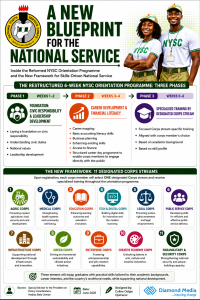
A New Blueprint for The National Service
Speaking further on the planned reforms, the Special Adviser to the President on Policy Coordination, Hadiza Bala Usman, said the six-week NYSC orientation programme would be restructured into three distinct phases aimed at building leadership capacity, improving employability and preparing corps members for specialised career pathways.
She explained that the first two weeks would focus on civic responsibility, national values and leadership development.
“So within the orientation camp, there’s a new structure where you have the first two weeks, which speaks to laying a foundation on civic responsibility. You’ll be made aware of what civic duties mean, our national values, and leadership development,” she said.
According to Usman, the next two weeks will concentrate on career development by equipping corps members with practical business and financial management skills.
“The next two weeks, we look to career mapping, basic accounting literacy skills, and business planning. We look to enhance the skills, of course, that the youth already have in order to make sure that they are able to access finance. How do we access finance? And then we intend to introduce a structured career day programme to enable Corp members to engage directly with the public,” she stated.
She added that the final two weeks of the orientation programme would be dedicated to specialised training aligned with each corps member’s academic background, career aspirations and selected professional stream.
“But importantly, the final two weeks, which is a minimal period, we intend to have focused Corp stream-specific training. This aligns with the Corp member’s designated stream based on his choice, based on his academic background and skill profile,” Usman said.
Under the new framework, corps members will select one of 11 specialised streams immediately after registration and will receive targeted training throughout the orientation programme in preparation for future employment and national service.
“We’ve designated 11 core streams across NYSC, so when you come as a youth corper, you would now pick which stream you want to participate in,” she explained.
The specialised streams include Agric Corps, Medical Corps, Education Corps, Tech and Digital Corps, Legal Corps, Public Service Corps, Infrastructure Corps, Green Corps, Enterprise Corps, Creative Economy Corps, and Paramilitary & Security Corps.
Usman said the reforms are designed to ensure graduates acquire practical, market-relevant skills while contributing to national development.
“NYSC will be civilian-led with clarity of the fact that we need to build the skill set of our youth to enable them to function and support the government in building a 1 trillion dollar economy,” she added.
She also noted that the reforms review deployment procedures, including how corps members are posted across states, with greater consideration for prevailing security realities.
Established in 1973 following the Nigerian Civil War, the NYSC was created to promote national unity by deploying graduates to states outside their regions of origin for one year of compulsory national service.
The latest reforms represent the first comprehensive review of the scheme since its creation, with the federal government saying the changes are intended to make the institution more responsive to Nigeria’s evolving economic realities and youth development priorities.