

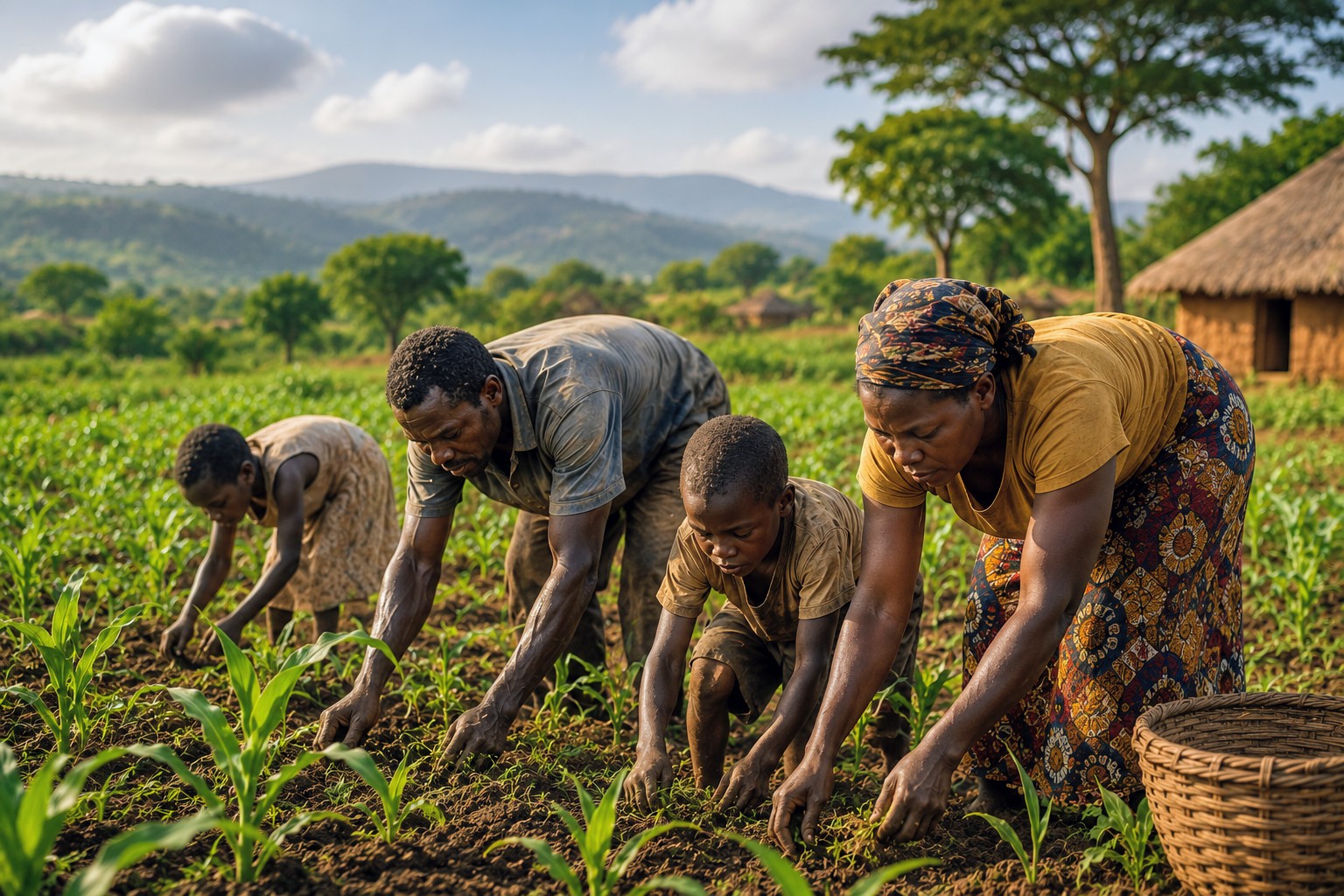
A new UN report says 645 million people remained hungry in 2025 despite gradual global progress, as rising food costs and widening inequalities threaten efforts to end hunger by 2030.
By Collins Odigie Ojiehanor
Global hunger declined for the third consecutive year in 2025, raising cautious hopes that the world is gradually recovering from the devastating impacts of the COVID-19 pandemic, economic shocks, and armed conflicts. Yet beneath the encouraging global trend, hunger is becoming increasingly concentrated in Africa, while billions of people worldwide still cannot afford healthy diets, threatening progress toward ending hunger by the end of the decade.
These findings are contained in the 2026 State of Food Security and Nutrition in the World (SOFI) report jointly released by the Food and Agriculture Organization (FAO), International Fund for Agricultural Development (IFAD), United Nations Children’s Fund (UNICEF), World Food Programme (WFP), and World Health Organization (WHO).
The report estimates that 645 million people, about 7.8 per cent of the world’s population, experienced hunger in 2025, down from 659 million in 2024 and 688 million in 2022. The improvement reflects sustained recovery across several regions, particularly Asia and Latin America and the Caribbean, where food security has continued to improve after years of disruption.
Despite the positive trend, the report cautions that hunger levels remain above those recorded before the COVID-19 pandemic and that the world is still significantly off track to achieve Sustainable Development Goal (SDG) 2 – Zero Hunger, by 2030. While millions fewer people are going hungry today than just three years ago, the pace of progress remains too slow to meet internationally agreed targets.
The findings present a stark paradox. Global hunger is declining, but the burden is becoming increasingly concentrated in the regions least equipped to withstand economic shocks, climate change, and conflict. At the same time, rising food prices and the growing cost of nutritious diets are leaving billions of people unable to access the foods needed for healthy lives.
Africa Now at the Centre of the Crisis
Nowhere is this challenge more evident than in Africa. According to the report, the continent has become the global epicentre of hunger, accounting for both the highest prevalence and the largest absolute number of undernourished people in the world.
Today, Africa is home to an estimated 309 million hungry people, surpassing Asia’s 292 million despite having a much smaller population. About one in every five Africans, 20 per cent of the continent’s population, experienced hunger in 2025, making Africa the region most severely affected by undernourishment.
Although Africa recorded a modest improvement, with hunger prevalence falling slightly from 20.3 per cent in 2024 to 20.0 per cent in 2025, the report notes that rapid population growth means the total number of hungry people continues to increase, underscoring the magnitude of the challenge confronting governments and development partners across the continent.
The report also shows that hunger is only one dimension of a much broader food security crisis. Globally, an estimated 2.1 billion people, 25.8 per cent of the world’s population, experienced moderate or severe food insecurity in 2025, meaning they were forced at different times during the year to reduce either the quality or quantity of the food they consumed.
While this represents nearly 86 million fewer people than in 2024 and 135 million fewer than in 2020, food insecurity remains significantly higher than before the pandemic, highlighting the continued vulnerability of millions of households.
Regional disparities remain particularly striking. According to the report, 56.6 per cent of Africa’s population experienced moderate or severe food insecurity, compared with 20.3 per cent in Asia, 22.9 per cent in Latin America and the Caribbean, and just 8.7 per cent in Northern America and Europe.
The burden also falls disproportionately on vulnerable populations. Food insecurity remains more widespread in rural communities than in urban areas, while women continue to experience higher levels of food insecurity than men, although the gender gap narrowed slightly during the year.
Taken together, the findings illustrate that while some regions are steadily recovering, Africa continues to shoulder a disproportionate share of the world’s hunger crisis, making the continent central to any realistic effort to achieve zero hunger by 2030.
Healthy Diets Still Out of Reach
Beyond the number of people going hungry, the report identifies the growing cost of healthy diets as one of the most significant barriers to ending global malnutrition.
A healthy diet, as defined jointly by FAO and WHO, is one that is adequate, balanced, diverse and moderate, supplying sufficient nutrients while reducing the risk of diet-related diseases.
According to the report, the average global cost of a healthy diet increased to 4.28 purchasing power parity (PPP) dollars per person per day in 2025, up from 3.44 PPP dollars in 2021 and 2.94 PPP dollars in 2017, reflecting continued increases in global food prices.
Although incomes have generally improved enough to reduce the number of people unable to afford healthy diets, from 2.97 billion people in 2021 to 2.69 billion in 2025, the report estimates that nearly one in every three people worldwide still cannot afford nutritious food.
Africa, however, continues to move in the opposite direction. The report estimates that 66.6 per cent of Africans were unable to afford a healthy diet in 2025, making the continent by far the least affordable region in the world for nutritious food. That proportion is more than double those recorded in both Asia and Latin America and the Caribbean.
Researchers say the disparity reflects structural weaknesses within agrifood systems rather than food production alone. While starchy staples remain relatively inexpensive, animal-source foods, fruits and vegetables account for nearly 70 per cent of the total cost of a healthy diet globally.
In Africa, animal-source foods represent the single most expensive component of healthy diets, placing balanced nutrition beyond the reach of millions of low-income households.
The report also identifies inefficiencies beyond the farm gate as major drivers of food prices. It estimates that post-farmgate activities, including processing, transportation, storage, logistics and wholesale distribution, account for between 70 and 75 per cent of what consumers ultimately pay for food, with as much as 40 per cent of total costs accumulating within these midstream segments of the food value chain.
The findings suggest that reducing hunger will require far more than increasing agricultural production. Instead, the report argues that investments in roads, irrigation systems, cold-chain infrastructure, agricultural research, logistics, trade facilitation and regulatory reforms are essential to lower food prices while improving the availability of nutrient-rich foods.
The report concludes that making healthy diets affordable is now one of the defining challenges of global food security, warning that unless countries strengthen food systems from production to distribution, millions of people will remain unable to access nutritious foods even where food is available.

What This Means for Nigeria
Although the SOFI report presents a global assessment, its findings closely mirror the realities confronting Nigeria, where soaring food prices, persistent inflation, insecurity, climate-related shocks and disruptions to agricultural production continue to make nutritious diets increasingly unaffordable for millions of households.
Across the country, families are increasingly being forced to make difficult choices about what they eat. While staple foods such as grains and tubers remain the primary source of calories for many households, protein-rich foods, fruits and vegetables have become significantly more expensive, reducing dietary diversity and pushing many families toward cheaper, calorie-dense alternatives with lower nutritional value.
The report’s findings that post-harvest losses, weak transport systems and inadequate cold-chain infrastructure contribute significantly to food costs are particularly relevant to Nigeria, where poor rural roads, inadequate storage facilities and high transportation costs continue to inflate food prices from farms to urban markets.
Speaking on the implications of the report for Nigeria, a nutritionist, Olusola Gbemisola, said the country’s food challenge is no longer simply about producing enough food.
“The issue today is affordability. Millions of Nigerians can still find food to eat, but many cannot afford the variety of foods needed for a healthy diet. That is why we’re seeing increasing cases of malnutrition alongside rising obesity and diet-related diseases.”
She added that improving agricultural productivity alone would not solve the problem unless governments invest in food processing, storage, transportation and market systems that reduce the cost of nutritious foods.
Gbemisola said Nigeria should draw lessons from the report by prioritising investments across the entire food value chain.
“Reducing post-harvest losses, improving rural roads, expanding irrigation and strengthening cold-chain infrastructure will make nutritious foods more available and more affordable. Those investments are just as important as increasing crop production.”
She also urged policymakers to strengthen social protection programmes that help vulnerable households maintain access to healthy diets during periods of economic hardship.
Her observations reinforce one of the report’s central messages: improving food production alone will not end hunger if nutritious foods remain beyond the financial reach of millions of people. For Nigeria, addressing structural bottlenecks across the food value chain may prove just as important as increasing agricultural output.
UN Leaders Call for Faster Action
The five United Nations agencies behind the report say the latest findings demonstrate that while reversing hunger is possible, sustaining progress will require stronger political commitment, increased investment and urgent reforms to make healthy diets affordable for everyone.
Commenting on the report, FAO Director-General QU Dongyu said the world has demonstrated that reversing hunger is possible but stressed that governments must accelerate action.
“The report shows that progress is possible, but we must move faster. Ending hunger and making healthy diets affordable requires political commitment, sustained investment and enabling policies. Recent crises – from natural disasters like the COVID-19 pandemic to man-made disasters like hotspots of conflicts, the war in Ukraine, the Gaza crisis, and the recent Strait of Hormuz disruption, have demonstrated both the resilience of agrifood systems and the need to strengthen them further to better serve the world’s most vulnerable people, farmers and consumers.”
His remarks reinforce the report’s central conclusion that recent gains remain fragile and could easily be reversed without sustained public investment and stronger agrifood systems.
Similarly, IFAD President Alvaro Lario said affordability, not merely food production, has become one of the defining challenges of global food security.
“SOFI tells us that the cost of a healthy diet continues to rise and that nearly 2.7 billion people may still be unable to afford a healthy diet. Resilient value chains must be a central part of the answer. Our task now is to turn the evidence SOFI provides into investment and to do so through partnership. Together, we can build the value chains, market systems and rural economies that make healthy food affordable for all.”
Lario said transforming food systems requires governments, development institutions and private-sector partners to invest in stronger agricultural value chains capable of making nutritious foods more affordable and accessible.
For children, the consequences of food insecurity remain particularly severe. UNICEF Executive Director Catherine Russell warned that millions of children continue to be denied the nutrition needed for healthy growth and development.
“Every child deserves the chance to grow and develop to their full potential, and this starts with access to nutritious, affordable food. This report is a stark reminder that food systems fail millions of children and families. Food, health, education and social protection must go hand in hand to protect the most vulnerable children and women from global shocks.”
Her comments echo the report’s warning that food insecurity is not merely a humanitarian issue but one that threatens children’s health, education, cognitive development and future economic productivity.
Responding to the report’s findings, World Food Programme (WFP) Acting Executive Director Carl Skau warned that behind the statistics are millions of families struggling daily to afford food.
“Behind every number in this report is a family counting the cost of food. Conflict and climate shocks push them further beyond their means. We must continue working with partner agencies, governments and communities to build food systems that hold up under shock so families can afford nutritious diets, even in times of crisis. We now need sustained investment to match the scale of the challenge.”
His remarks highlight the report’s conclusion that conflict, climate change and economic instability continue to undermine household purchasing power, particularly among vulnerable communities already facing food insecurity.
Similarly, WHO Director-General Dr Tedros Adhanom Ghebreyesus said tackling hunger alone is no longer sufficient unless governments also improve access to healthy diets.
“While we welcome the clear progress we have made in reducing hunger, a healthy diet still remains unaffordable for one in three people globally. Obesity is rising, and progress on maternal and child nutrition is stalling. But we know what works, policies that make healthy food the easy choice, promoting breastfeeding, front-of-pack labelling, taxing unhealthy products, and protecting children from harmful marketing. Healthy diets are not a luxury, they are the foundation of health and must be within everyone’s reach.”
Collectively, the UN leaders’ messages underscore a common conclusion: ending hunger is no longer simply about producing more food. It requires transforming food systems so that healthy diets become affordable, accessible and resilient in the face of conflict, climate change and future global shocks.
Nutrition Targets Slip Further Out of Reach
While the world has made measurable progress in reducing hunger, the report warns that advances in nutrition, particularly for women and children, remain alarmingly slow, placing global nutrition targets increasingly beyond reach.
Despite years of international investment, indicators measuring child stunting, wasting, low birthweight, childhood overweight and exclusive breastfeeding have improved only marginally, while anaemia among women and adult obesity continue to worsen.
According to the report, approximately 150 million children under the age of five remain stunted, meaning they are too short for their age because of chronic undernutrition. Stunting can permanently affect a child’s physical growth, brain development, educational attainment and future earning potential.
Dietary diversity also remains critically low across the world. Only 30.8 percent of children aged between six and 23 months consume a minimally diverse diet, meaning that more than two-thirds of young children fail to receive the variety of foods needed for healthy growth and development.
Among women aged 15 to 49 years, only 62.7 per cent consume a minimally diverse diet, leaving roughly one in three women at risk of deficiencies in essential vitamins and minerals.
The situation is particularly concerning in Africa, where only 20.5 per cent of children aged six to 23 months achieve minimum dietary diversity, while just 43 per cent of women of reproductive age consume adequately diverse diets, the lowest regional levels recorded globally.
The report further shows that anaemia among women aged 15 to 49 years increased from 27.6 per cent in 2012 to 30.7 per cent in 2023, with projections suggesting it could rise further to 32.6 per cent by 2030, moving the world even farther from the target of reducing anaemia by half.
Meanwhile, obesity is emerging as another major global health challenge. The prevalence of adult obesity increased steadily from 12.1 per cent in 2012 to 16.2 per cent in 2024 and is projected to climb to 18.6 per cent by 2030, despite the international commitment to halt its rise.
The report notes that these contrasting trends, persistent undernutrition alongside rising obesity, illustrate the growing complexity of global malnutrition, where poor diet quality rather than food quantity alone is increasingly shaping health outcomes.
The findings serve as a reminder that ending hunger alone will not guarantee better nutrition. Without sustained investments in maternal and child health, dietary diversity, nutrition education and affordable access to nutrient-rich foods, millions of people will continue to suffer from both undernutrition and diet-related diseases, even in countries where food is available.
New Threats Could Reverse Progress
While the gradual decline in global hunger offers reasons for cautious optimism, the report warns that the gains remain highly fragile and could easily be reversed unless countries strengthen their resilience against emerging global shocks.
According to the report, conflict continues to be the single largest driver of acute food insecurity worldwide. Armed violence disrupts agricultural production, destroys infrastructure, displaces farming communities and interrupts food supply chains, leaving millions dependent on humanitarian assistance.
Climate change is compounding these challenges. More frequent droughts, floods, heatwaves and unpredictable rainfall patterns are reducing agricultural productivity across many low- and middle-income countries, particularly in sub-Saharan Africa, where livelihoods remain heavily dependent on rain-fed agriculture.
The report also notes that economic slowdowns, persistent inflation and rising public debt continue to weaken governments’ ability to invest in agriculture, nutrition and social protection programmes at a time when millions remain vulnerable.
Recent geopolitical crises have further exposed the fragility of global agrifood systems. Supply chain disruptions, volatile energy prices and increasing transportation costs have all contributed to higher food prices, making healthy diets even less affordable for vulnerable populations.
The report cautions that without stronger resilience measures, future shocks, whether caused by conflict, climate change, economic crises or disease outbreaks, could erase much of the progress achieved in reducing hunger over the past three years.
It therefore calls on governments to move beyond emergency responses by investing in long-term resilience that enables food systems to withstand future disruptions while protecting the livelihoods of farmers and consumers alike.
The Road to Zero Hunger
Despite the challenges, the report maintains that ending hunger by 2030 remains technically achievable if countries accelerate action and invest strategically across entire agrifood systems.
Rather than focusing solely on increasing food production, the report advocates a comprehensive transformation that improves how food is produced, processed, transported, marketed and consumed.
According to the report, resilient agrifood systems are essential for making nutritious foods more available, affordable and accessible to all people.
This includes investing in agricultural research and innovation, irrigation infrastructure, climate-smart farming, rural roads, storage facilities, cold-chain systems, digital technologies, logistics networks and efficient wholesale markets.
The report also highlights the importance of reducing food loss and waste throughout the supply chain. Large quantities of nutritious food are lost before reaching consumers because of inadequate storage, inefficient transportation systems and weak market infrastructure. Addressing these challenges would improve food availability while helping to reduce consumer prices.
Equally important is expanding social protection programmes that enable poor and vulnerable households to maintain access to healthy diets during periods of economic hardship.
The report argues that targeted investments in school feeding programmes, maternal and child nutrition interventions, cash transfers and nutrition-sensitive agricultural policies can simultaneously reduce hunger, improve health outcomes and strengthen long-term human capital development.
Ultimately, the report concludes that achieving Zero Hunger will require coordinated action involving governments, development partners, research institutions, the private sector and local communities.
No single intervention will be sufficient on its own. Instead, sustained collaboration across multiple sectors will be necessary to transform food systems into engines of nutrition, resilience and inclusive economic growth.

Africa Requires a Different Strategy
While many of the report’s recommendations apply globally, the findings suggest that Africa requires a more tailored and accelerated response because of the continent’s unique demographic, economic and climatic realities.
With the world’s highest hunger prevalence, fastest population growth and greatest proportion of people unable to afford healthy diets, Africa faces a challenge unlike any other region.
The report notes that simply increasing agricultural output will not be enough. Governments across the continent must simultaneously improve productivity, strengthen rural infrastructure, reduce post-harvest losses, expand access to markets and create resilient value chains capable of delivering affordable, nutritious foods to rapidly growing urban and rural populations.
Climate adaptation will also be central to Africa’s food future. The report recommends expanding climate-smart agriculture, improving water management, increasing irrigation coverage, strengthening early warning systems and promoting agricultural practices that enable farmers to cope with increasingly unpredictable weather patterns.
Equally important is investing in women and young people, who play critical roles throughout Africa’s food systems. Improving access to finance, technology, extension services and markets for smallholder farmers, particularly women, could significantly increase food production while improving household nutrition and incomes.
The report also calls for stronger regional cooperation to improve intra-African agricultural trade, reduce food losses across borders and strengthen food supply chains capable of responding more effectively to future crises.
Taken together, these measures offer Africa an opportunity not only to reduce hunger but also to transform its agrifood systems into drivers of economic growth, employment and long-term resilience.
Progress, But Time Is Running Out
The latest SOFI report paints a picture of cautious optimism tempered by growing urgency. For the third consecutive year, global hunger has declined, demonstrating that progress is possible when governments, international organisations and development partners work together.
Yet the report makes clear that today’s improvements remain insufficient to achieve the world’s shared commitment of ending hunger and all forms of malnutrition by 2030. Millions of people continue to struggle daily with food insecurity, while nearly one-third of the global population still cannot afford healthy diets.
Africa, in particular, remains at the centre of the global food crisis, carrying a disproportionate share of the world’s hungry despite accounting for a much smaller share of the global population.
At the same time, worsening child nutrition, rising obesity, persistent anaemia among women and increasing climate-related shocks illustrate that the challenge extends well beyond food availability.
The report therefore warns that unless governments accelerate investments in resilient agrifood systems and nutrition-sensitive policies, the world risks falling even further behind on the Sustainable Development Goals.
A Call for Urgent Collective Action
Ultimately, the 2026 State of Food Security and Nutrition in the World report delivers a message that is both encouraging and cautionary.
The decline in global hunger demonstrates that meaningful progress is achievable. However, the persistence of widespread food insecurity, the growing inability of billions to afford healthy diets and the widening inequalities between regions underscore that much more remains to be done.
The report calls on governments, development partners, financial institutions, civil society organisations and the private sector to seize this moment by investing in food systems that are more resilient, inclusive and nutrition-sensitive.
For countries such as Nigeria, where rising food prices continue to place nutritious diets beyond the reach of many households, the report offers both a warning and a roadmap.
The challenge is no longer simply producing enough food to feed growing populations. It is ensuring that every person, regardless of income or location, has access to food that is affordable, safe and nutritious.
As the countdown to 2030 continues, the report concludes that the choices governments make today will determine whether the world succeeds in delivering on its promise of Zero Hunger, or leaves millions more behind.
The message from the world’s leading food and health agencies is unequivocal: progress is possible, but only if urgency is matched with sustained political commitment, strategic investment and collective global action.