


By Collins Odigie Ojiehanor
On April 14, 2015, Rasheed Adetunji left home in Lagos expecting to return before nightfall. Instead, plainclothes officers attached to the now-defunct Special Anti-Robbery Squad (SARS) arrested him and took him into custody.
Days turned into weeks. Weeks became months. Months became years.
Adetunji, a disc jockey trying to build a livelihood in Lagos, remained behind bars awaiting trial. His vehicle was seized. His heavily pregnant wife, unable to cope financially, eventually left after being evicted from their rented apartment. His blind father, living in Ibadan, could only watch helplessly as his son disappeared into Nigeria’s criminal justice system.
By the time journalists documented his story years later, Adetunji had already spent several years in detention, more than many convicted offenders spend serving their sentences. He had not been convicted of the offense for which he was being held, yet the wheels of justice appeared to move painfully slowly.
His story is not unique. Across Nigeria, thousands of suspects remain in correctional facilities for months or years before their cases are concluded.
For victims, delayed trials prolong grief and uncertainty. For defendants, justice postponed often feels indistinguishable from punishment. For families, every adjournment carries another emotional and financial cost.
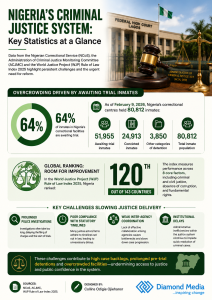
The scale of the problem is reflected in official figures from the Nigerian Correctional Service (NCoS). According to a report, appearing before the House of Representatives Committee on Reformatory Institutions to defend the NCoS 2026 budget estimates, Controller-General of Corrections Sylvester Nwakuche disclosed that 64 percent of inmates in Nigeria’s correctional facilities are awaiting trial.
Nwakuche stated that as of February 9, 2026, Nigeria’s correctional centers held 80,812 inmates, comprising 51,955 awaiting-trial inmates and 24,913 convicted inmates, while 3,850 were under other categories of detention.
These figures mean that nearly two out of every three inmates in Nigeria’s correctional facilities are awaiting trial rather than serving sentences after conviction.
President Bola Ahmed Tinubu has proposed the Administration of Criminal Justice Bill, 2026, a sweeping reform intended to overhaul how criminal cases are handled in Nigeria. However, whether the legislation will deliver on that promise remains the question now before the lawmakers and the nation as the bill undergoes legislative scrutiny.

Why Are Cases Delayed?
The Administration of Criminal Justice Monitoring Committee (ACJMC) has repeatedly identified prolonged police investigations, poor compliance with statutory timelines, weak inter-agency coordination, and institutional delays as some of the major factors responsible for slow justice delivery.
Similarly, the Criminal Justice Reporting Portal‘s Eight-Point Reform Agenda identified several systemic issues driving the persistent backlog of criminal cases across the country. It noted that the justice system remains heavily dependent on manual record-keeping and physical court processes, with limited adoption of digital case management systems and electronic recording of suspects’ statements.
These outdated practices can often lead to misplaced case files, slow transmission of records, and unnecessary delays in scheduling hearings.
Justice experts also point to delay in obtaining legal advice from the Director of Public Prosecutions (DPP). Many inmates spend months or years awaiting the DPPs’ legal advice to determine whether there is sufficient evidence to prosecute them. These delays stall criminal proceedings, prolong pre-trial detention, contribute to prison overcrowding, and undermine the right to a timely trial.
Another major concern is the poor compliance with the provisions of the ACJA by some law enforcement agencies and prosecuting authorities, particularly in meeting prescribed timelines for investigations, legal advice, and remand procedures.
In many instances, delays in concluding police investigations or forwarding legal advice to the courts mean suspects remain in custody for months or even years before their trials begin.
Despite provisions in the Administration of Criminal Justice Act (ACJA), 2015, designed to limit unnecessary adjournments, courts continue to grant repeated extensions in many criminal matters, resulting in prolonged trials and lengthy periods of pretrial detention.
Similarly, inadequate funding, a shortage of judges, insufficient courtrooms, and the growing number of criminal cases filed annually are additional factors contributing to delays.
Frequent transfers of judicial officers, congested court dockets, and poor coordination among the police, prosecutors, correctional authorities, and the judiciary often compound the problem, causing cases to drag on far longer than necessary.
Legal practitioner Barrister Joy Oluwasemilore said the delays stem not from a single institution but from weaknesses across the entire criminal justice chain.
“The challenge is not simply that the courts are slow. Every institution involved in the criminal justice process has a role to play. If investigations are not concluded on time, prosecutors cannot proceed. If prosecutors are unprepared, courts are forced to adjourn matters. The result is a cycle of delay that affects everyone.”
According to her, effective implementation of existing laws is just as important as introducing new reforms.
“The ACJA already contains several progressive provisions aimed at speeding up criminal proceedings. Unfortunately, compliance has not been consistent. Before introducing new reforms, government institutions must demonstrate a genuine commitment to implementing the laws that already exist.”
She maintained that technology and stronger institutional coordination would be critical to improving justice delivery.
“Digital case management, electronic filing, proper record management, and better coordination among the police, prosecutors, correctional authorities, and the courts would significantly reduce avoidable delays.”
“Reform should not stop at changing the law; it must also change how the institutions responsible for administering justice operate,” she added.
While the high number of awaiting-trial inmates reflects the scale of the problem, justice sector stakeholders say the figures are symptoms of deeper structural weaknesses that continue to undermine Nigeria’s criminal justice system.
The Cost of Delayed Justice
The Administration of Criminal Justice Act (ACJA), enacted in 2015, was itself introduced to speed up criminal proceedings and improve coordination among police, prosecutors, courts, and correctional authorities.
More than a decade later, however, delays continue to define many criminal trials. Cases are repeatedly adjourned because witnesses fail to appear, prosecutors are unprepared, defense lawyers seek additional time, judges are transferred or retire before concluding proceedings, or investigations remain incomplete.
In many instances, trials restart from the beginning after years of hearings because a new judge is assigned to the case.
For thousands of Nigerians, the slow pace of criminal trials is not merely a legal inconvenience; it is a life-changing reality.
Behind every adjourned hearing is a defendant waiting to clear their name, a victim seeking closure, or a family struggling with the emotional and financial burden of an unresolved case.
Data from the official NCoS portal shows that the service currently manages 253 correctional centers across the country, many of which continue to struggle with overcrowding driven largely by the high number of awaiting-trial inmates.
The consequences of prolonged trials have also been evident in several high-profile cases. The terrorism trial of IPOB leader Nnamdi Kanu, which began years ago, has experienced repeated interruptions due to judicial recusals, changes of judges, and procedural disputes. In March 2025, the case commenced before a fourth judge, illustrating how changes in judicial officers can significantly prolong criminal proceedings.
Similarly, human rights advocates have continued to raise concerns over the prolonged detention of thousands of awaiting-trial inmates. On July 2, 2026, the Tunji Braithwaite Foundation urged the government to accelerate criminal trials, warning that many Nigerians presumed innocent remain in correctional facilities for years without their cases being concluded.
Barrister Oluwasemilore believes the consequences of delayed trials extend beyond the courtroom.
“Every unnecessary adjournment comes at a cost. Victims are denied timely justice, defendants continue to live under uncertainty, witnesses become more difficult to locate, and public confidence in the justice system gradually erodes,” she said.
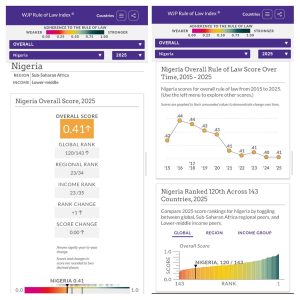
In the World Justice Project (WJP) Rule of Law Index 2025, Nigeria ranked 120th out of 143 countries, underscoring persistent weaknesses in the administration of justice.
The index evaluates countries across eight key indicators, including criminal justice, civil justice, constraints on government powers, absence of corruption, open government, regulatory enforcement, order and security, and the protection of fundamental rights.
Nigeria’s ranking points to continuing concerns over delays in criminal proceedings, access to justice, and the effective enforcement of the rule of law.
What the Administration of Criminal Justice Bill 2026 Proposes
The proposed Administration of Criminal Justice Bill, 2026, seeks to repeal and replace the Administration of Criminal Justice Act (ACJA), 2015, which has served as Nigeria’s principal legal framework for criminal procedure in federal courts for over a decade.
According to the presidency, the new bill is designed to modernize the criminal justice system by reducing delays, improving efficiency, strengthening victim and witness protection, and ensuring quicker resolution of criminal cases.
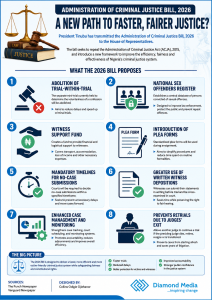
Among its most significant provisions is the abolition of the “trial-within-trial” procedure, a separate hearing currently conducted whenever an accused person alleges that a confessional statement was obtained through torture, threats, or coercion.
The government argues that removing this procedure will eliminate one of the major causes of prolonged criminal trials, although legal experts are already debating whether the change could weaken safeguards for defendants’ constitutional rights.
The bill also proposes the establishment of a National Sex Offenders Register, creating a central database of persons convicted of sexual offenses. The register is intended to improve law enforcement, enhance public safety, and help prevent repeat sexual offenses by making information on convicted offenders more accessible to relevant authorities.
To improve witness participation in criminal proceedings, the bill introduces a Witness Support Fund. The fund is expected to provide financial and logistical assistance to witnesses who often face transportation costs, loss of income, and intimidation while participating in lengthy court proceedings.
Another key proposal is the introduction of plea forms to simplify arraignment procedures and reduce time spent on routine court formalities. The bill further encourages greater use of written witness depositions, allowing witnesses to submit their evidence in writing before appearing in court for cross-examination, a measure aimed at speeding up trials without eliminating oral testimony.
To curb unnecessary delays, the bill prescribes mandatory timelines within which courts must determine no-case submissions filed by defendants after the prosecution closes its case. It also strengthens case management and monitoring mechanisms to improve judicial efficiency and accountability in the handling of criminal matters.
Perhaps one of the most practical reforms addresses a long-standing challenge in Nigerian courts, criminal trials that begin afresh because the presiding judge dies, retires, resigns, or is transferred.
The proposed legislation contains provisions that would allow another judge to continue such proceedings under specified conditions, potentially saving years of litigation and reducing the burden on victims, witnesses, and defendants.
Collectively, the proposals signal an attempt to strike a balance between speeding up criminal proceedings and improving the administration of justice.
Legal Perspectives: The Debate Over Abolishing Trial-within-Trial
Among the most contentious provisions of the proposed Administration of Criminal Justice Bill, 2026, is the abolition of the trial-within-trial procedure, a legal mechanism designed to determine whether an accused person’s confessional statement was made voluntarily before it is admitted as evidence.
For the Head of Chamber and Managing Partner, Olaseinde Karim & Co., Barrister Patrick Olenloa Ojiehanor, the proposal reflects an attempt to address one of the longest-standing bottlenecks in Nigeria’s criminal justice system. However, he cautions that any effort to accelerate criminal trials must not erode the constitutional rights of accused persons.
Explaining the rationale behind the existing procedure, Ojiehanor said a trial-within-trial serves as an important safeguard against coerced confessions.
“A trial-within-trial is a special procedural mechanism used in Nigerian criminal courts to determine whether an accused person’s confessional statement was made voluntarily. Under Section 29 of the Evidence Act, 2011, an involuntary confession is inadmissible because a confession alone can be sufficient to secure a conviction. The court therefore acts as a gatekeeper to distinguish genuine statements from those extracted through torture, threats, or inducement.”
He explained that whenever the prosecution seeks to tender a confessional statement and the defense alleges that it was obtained through coercion, the trial judge suspends the substantive proceedings to conduct a separate hearing.
During that hearing, the prosecution is required to prove that the statement was made voluntarily, while the defense has the opportunity to challenge the circumstances under which it was obtained.
According to him, although the procedure was introduced to protect fundamental rights, it has increasingly become a major source of delay in criminal proceedings.
“The proposal to abolish the trial-within-trial procedure reflects a desperate but understandable attempt by the executive and the judiciary to cure the chronic delays paralysing Nigeria’s criminal justice system. For decades, these mini-trials have been weaponized as a delay tactic, causing cases to drag on for years because of interlocutory appeals.”
He noted that existing reforms under the Administration of Criminal Justice Act (ACJA), 2015, already seek to minimize disputes over confessional statements by requiring that they be video-recorded or obtained in the presence of a legal practitioner or an independent witness.
Nevertheless, Ojiehanor warned that abolishing the procedure entirely could have unintended consequences.
“Completely scrapping the procedure is a double-edged sword. While it will undoubtedly accelerate criminal trials, it shifts the focus from preventing contaminated evidence from entering the record to managing it after the damage has already been done.”
He expressed concern that once an allegedly coerced confession is read in open court, it may continue to influence the trial, even if it is eventually ruled inadmissible.
“Once a highly prejudicial confession has been read and recorded by the trial judge, it becomes psychologically difficult to completely erase its influence from the final judgment, even where the court ultimately decides that it should not have been admitted.”
The legal practitioner further argued that removing the trial-within-trial mechanism could weaken constitutional protections guaranteed under the 1999 Constitution and the Evidence Act, 2011.
“The current procedure serves as an immediate barrier against involuntary confessions. Without that gatekeeping function, an accused person may spend months or years defending himself against a document that should never have formed part of the trial in the first place.”
He also warned that defendants with limited financial resources could be disproportionately affected.
“Those who cannot afford experienced legal representation may find it even more difficult to challenge the psychological weight that an improperly admitted confession could carry, particularly in lower courts where judicial officers are already under pressure to dispose of cases quickly.”
Rather than simply abolishing the procedure, Ojiehanor urged lawmakers to introduce stronger statutory safeguards capable of protecting both efficiency and fairness.
Among his recommendations is a mandatory “No Video, No Confession” rule that would render inadmissible any confessional statement not captured through an unedited video recording or obtained in the presence of legal counsel.
“If the prosecution cannot produce objective proof that a confession was obtained voluntarily, the court should reject it immediately without the need for a mini-trial or waiting until the final judgment.”
He also proposed introducing time-bound pre-trial admissibility hearings, where disputes over confessional statements would be determined before the substantive trial begins.
“Any objection to the voluntariness of a confession should be resolved at a dedicated pre-trial hearing within a clearly defined period, say, not more than 14 days without interlocutory appeals that delay the main trial.”
In addition, he recommended what he described as prejudicial redaction protocols, under which the contents of a disputed confession would remain sealed until the court first determines whether it was voluntarily made.
Finally, he called for tougher sanctions against law enforcement officers who obtain confessional statements through torture or other unlawful means.
“There should be strict criminal and civil penalties for any investigator found to have used torture or duress. Where coercion is established, the law should require the immediate dismissal and prosecution of the officer involved. That is the strongest deterrent against abuse.”
For Ojiehanor, the objective of the proposed legislation should not merely be to conclude criminal cases more quickly but to ensure that speed does not come at the expense of justice.
“The challenge before the National Assembly is to strike the right balance. Nigeria needs a criminal justice system that is efficient, but it must also remain fair, constitutional, and capable of protecting the rights of every citizen,” he said.
Balancing Speed with Fairness
According to Oluwasemilore, the proposed Administration of Criminal Justice Bill, 2026, represents an opportunity to address many of these long-standing challenges, provided the reforms are matched by effective implementation.
“The law alone cannot solve the problem. There must be adequate funding, improved coordination among criminal justice institutions, and a commitment by every stakeholder to comply with the timelines prescribed by law. Without implementation, even the best reforms will remain ineffective.”
She added that while speed is important, efficiency should never come at the expense of fairness.
“The objective should be a justice system that is both timely and fair. Citizens should not have to wait years before their cases are determined, but every accused person must also retain the constitutional right to a fair hearing.”
For Barrister Samuel Bolaji, he believes the proposed Administration of Criminal Justice Bill, 2026, could significantly improve Nigeria’s criminal justice system by reducing delays that have long undermined public confidence in the courts.
According to him, prolonged criminal proceedings have left many defendants spending years awaiting trial, while victims and their families endure lengthy waits for justice.
“The proposed bill has the potential to significantly improve the efficiency of Nigeria’s criminal justice system if it is properly implemented,” he said.
“One of the biggest challenges in our courts today is the delay in concluding criminal cases. Many defendants spend years awaiting trial, while victims and their families are forced to wait indefinitely for justice,” he added.
Bolaji noted that measures aimed at improving case management and reducing unnecessary delays would benefit all stakeholders in the justice system.
“If criminal matters are concluded within a reasonable time, victims would receive timely justice, defendants would have their cases determined without prolonged uncertainty, lawyers would experience more efficient court proceedings, and judges would be better equipped to manage their caseloads,” he said.
“Ultimately, a more efficient criminal justice system would strengthen public confidence in the judiciary and reinforce the constitutional principle that justice delayed is justice denied.”
He also welcomed the bill’s proposal to establish a National Sex Offenders Register and a Witness Support Fund, describing both as important reforms that could strengthen the administration of criminal justice.
While the Witness Support Fund could encourage victims and witnesses to participate more confidently in criminal proceedings, Bolaji said the proposed sex offenders register must incorporate adequate safeguards to prevent innocent people from being wrongly identified.
“In Nigeria, many individuals share the same names. If the register relies solely on names, there is a real risk that someone with a similar name could be unfairly victimized or mistaken for a convicted offender,” he said.
To address that concern, he recommended that the register include additional identifying information.
“The register should contain reliable means of identification, such as passport photographs and other verified biometric information, to ensure that only the actual convicted offender is identified. Proper safeguards are essential to protect the rights and reputations of innocent citizens.”
On another key provision of the bill, which would allow a new judge to continue hearing a criminal case where the original judge dies, retires, or is transferred, Bolaji said the reform could substantially reduce delays that often force trials to begin afresh.
“Allowing another judge to continue from where the previous judge stopped would help preserve judicial time and prevent years of proceedings from being wasted,” he said.
He, however, cautioned that the reform should not come at the expense of the constitutional right to a fair hearing.
“The succeeding judge should have full access to the complete record of proceedings and must be satisfied that continuing the trial would not prejudice either the prosecution or the defense. If these safeguards are respected, the reform can improve efficiency while maintaining the integrity and fairness of criminal trials.”
Beyond the Courtroom
While lawyers debate the legal implications of the proposed reforms, other justice stakeholders say success will depend on how the law is implemented.
An officer of the Nigerian Correctional Service, who requested anonymity, said reducing delays in criminal trials would significantly ease congestion in correctional centers, where a large proportion of inmates are awaiting trial.
According to him, prolonged criminal proceedings contribute to overcrowding and place enormous pressure on correctional facilities and personnel.
“The majority of the pressure on our correctional centers comes from the number of awaiting-trial inmates. If criminal cases are concluded more quickly, it will reduce congestion, improve the management of our facilities, and create better living conditions for inmates, while also making the work of correctional officers more effective,” he said.
He added that while legislative reforms are important, their success would ultimately depend on effective implementation, adequate funding, and stronger collaboration among the police, the judiciary, prosecutors, and correctional authorities.
A human rights advocate, Ms. Josie Emmanuel, welcomed proposals such as the Witness Support Fund and the National Sex Offenders Register, saying they could make victims and witnesses more willing to participate in criminal proceedings.
“The establishment of a Witness Support Fund is a welcome development because many witnesses are discouraged from participating in criminal trials due to the financial and emotional burden involved. When witnesses receive the necessary support, they are more likely to appear in court and give credible evidence.”
On the proposed National Sex Offenders Register, she said:
“A national sex offender register has the potential to strengthen the protection of women, children, and other vulnerable members of society. It can help law enforcement agencies monitor convicted offenders and reduce the risk of repeat offenses.”
However, she warned that passing the law alone would not guarantee success.
“The effectiveness of these reforms will depend largely on implementation. The government must provide adequate funding, establish clear administrative structures, and ensure that the relevant institutions have the capacity to manage these initiatives effectively.”
She also stressed the importance of protecting the rights of those whose information would be contained in the register.
“There must also be strong privacy and data protection safeguards. While the public deserves protection from sexual offenders, the register should only contain information relating to persons who have been lawfully convicted, and access to such information must be properly regulated to prevent abuse.”
According to her, the reforms should ultimately strengthen both justice and public confidence.
“If these provisions are properly implemented, they could improve victims’ confidence in the justice system, encourage greater cooperation from witnesses, and ultimately contribute to more effective prosecution of criminal offenses.”
The Bottom Line
For Nigerians like Rasheed Adetunji, justice was measured not only in court rulings but also in years lost to delay.
The Administration of Criminal Justice Bill, 2026, offers an opportunity to confront many of the procedural bottlenecks that have long slowed criminal trials.
Its proposals, ranging from stricter case management to witness support and judicial continuity, could make the justice system more responsive and efficient.
But speed cannot become an end in itself. A criminal justice system earns public confidence not simply because it concludes cases quickly but because it reaches outcomes that are lawful, transparent, and fair.
As the National Assembly considers this landmark legislation, one question should guide every amendment and every debate: Can Nigeria make justice faster without making it less fair?