

By Collins Odigie Ojiehanor
Growing insecurity, persistent killings and increasing cases of violence against vulnerable groups have heightened public anxiety across Nigeria, with many citizens warning that human rights are becoming increasingly difficult to guarantee unless authorities take decisive action.
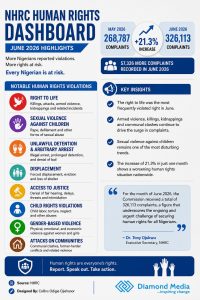
This concern follows the latest Human Rights Situation Dashboard released by the National Human Rights Commission (NHRC), which revealed that 326,113 human rights complaints were recorded across the country in June 2026, representing a significant increase from the 268,787 complaints recorded in May 2026.
The latest figure shows an increase of 57,326 complaints, representing about 21.3 per cent in just one month, highlighting the worsening human rights situation nationwide.
Presenting the Commission’s June Human Rights Situation Dashboard in Abuja, the Executive Secretary of the NHRC, Dr. Tony Ojukwu, described the figures as evidence of an “ongoing and urgent challenge” confronting Nigeria.
“For the month of June 2026, the Commission received a total of 326,113 complaints, a figure that underscores the ongoing and urgent challenge of securing human rights for all Nigerians. The right to life was the most frequently violated right, while the dominant pattern of armed violence remained consistent,” Ojukwu said.
According to the Commission, the right to life remained the single most violated human right in June, reflecting the continued impact of armed attacks, killings, kidnappings and other forms of violence affecting several parts of the country.
The report also identified sexual violence against children as one of the most disturbing trends during the month.
“The Observatory recorded several cases of sexual violence against minors in June. This pattern of sustained unresolved violence demands urgent and coordinated intervention as a country,” Ojukwu warned.
The NHRC noted that the figures reflect continued threats posed by insurgency in the North-East, banditry and kidnappings across the North-West and North-Central, communal conflicts, farmer-herder clashes, attacks on rural communities and other forms of violence that continue to expose civilians to grave human rights abuses.
June Figures Build on Already Troubling May Dashboard
The June dashboard represents a worrying escalation from the Commission’s May report.
In May 2026, the NHRC documented 268,787 human rights complaints, with the dashboard showing widespread violations ranging from killings and unlawful detention to gender-based violence, child rights abuses, displacement and other violations of fundamental freedoms.
Although May already painted a troubling picture, the additional 57,326 complaints recorded in June suggest that existing interventions have yet to significantly reduce abuses.
Human rights observers say the month-to-month increase raises concerns about deteriorating security conditions, weak accountability mechanisms and inadequate protection for vulnerable populations.
The June report also coincided with the official visit of the United Nations Special Rapporteur on Freedom of Religion or Belief, Professor Nazila Ghanea, who undertook a 12-day mission to Nigeria between June 8 and June 19, visiting Abuja, Plateau and Kano states.
Presenting her preliminary observations at the NHRC headquarters, Professor Ghanea noted that persistent violence, kidnappings, mass displacement and repeated attacks on communities continue to undermine fundamental rights while aggravating religious tensions across the country.
Her observations reinforced the Commission’s findings that insecurity remains one of the greatest threats to the protection of human rights in Nigeria.
NHRC Warns Against Human Rights Risks in State Police Proposal
Responding to ongoing conversations around the establishment of state police, Ojukwu cautioned that any policing reform must be accompanied by strong safeguards against abuse.
He warned that political interference, inadequate training, poor oversight and weak accountability structures could expose citizens to fresh violations if reforms are not carefully implemented.
The Commission also renewed its call for justice for victims of the Yelewata massacre in Benue State, lamenting that one year after more than 100 people were reportedly killed, many survivors remain displaced and continue to live without adequate humanitarian support.
It urged security agencies to intensify civilian protection, ensure speedy prosecution of perpetrators, strengthen child protection systems, improve school safety and expand psychosocial support for victims of violence.
Police Service Commission Backs Human Rights Dashboard
The Police Service Commission (PSC) endorsed the NHRC initiative, describing the Human Rights Situation Dashboard as an important instrument for promoting transparency, accountability and evidence-based reforms within Nigeria’s security institutions.
Chairman of the Commission, DIG Hashimu Salihu Argungu (Rtd.), represented by the Assistant Director of Legal Services, Victoria Onyekwuluje, during the presentation of the June Human Rights Situation Dashboard in Abuja, said the dashboard would provide credible data to guide policy decisions and institutional reforms.
“The Police Service Commission recognises the critical role of credible data and objective assessment in advancing human rights, strengthening democratic governance, improving public trust and promoting responsible governance,” he said.
He added that the initiative would help government institutions identify existing gaps, measure progress and strengthen collaboration with civil society organisations and development partners.
Rights Advocates Call for Urgent Institutional Reforms
Reacting to the NHRC’s latest dashboard, human rights advocate Babatunde Olamide described the sharp rise in reported violations as evidence of deeper institutional failures rather than merely a rise in criminal activities.
“These figures should concern every Nigerian because they point to systemic failures in protecting constitutionally guaranteed rights. When the right to life consistently emerges as the most violated right, it means the primary responsibility of the state, to protect lives and property, is being undermined,” he said.
Olamide noted that human rights cannot flourish in an environment where insecurity, impunity and delayed justice persist.
“Security agencies must not only respond more effectively to violent crimes but must also operate within the limits of the law. Every unlawful killing, arbitrary detention or abuse by state or non-state actors weakens public confidence in democratic institutions,” he added.
He urged government at all levels to strengthen accountability mechanisms and support institutions responsible for protecting citizens’ rights.
“Government should strengthen investigations, ensure prompt prosecution of offenders, adequately compensate victims where necessary and empower institutions such as the National Human Rights Commission to carry out their constitutional responsibilities without interference,” he said.
Similarly, legal practitioner Barrister Zainab Akinyemi said the NHRC Human Rights Situation Dashboard should be treated as an early warning system rather than simply a compilation of statistics.
“The dashboard highlights trends that require immediate policy attention. Rising complaints suggest that many Nigerians either remain exposed to violence or increasingly feel compelled to report violations because existing protections are inadequate,” she said.
According to Akinyemi, safeguarding human rights requires more than deploying security personnel to troubled areas.
“Protecting human rights requires more than deploying security personnel. It demands improved intelligence gathering, community policing built on trust, stronger oversight of law enforcement agencies and greater investment in justice institutions,” she said.
She also expressed concern over the increasing cases of sexual violence against children recorded in the NHRC report.
“The increase in child sexual violence is particularly alarming because such abuses have lifelong consequences. Government must strengthen child protection services, expand psychosocial support for survivors and ensure that perpetrators face swift prosecution,” she said.
Akinyemi stressed that governments should be held accountable for protecting the rights of citizens.
“Ultimately, human rights protection should become a measurable performance indicator for every level of government,” she added.
Nigerians Say Fear Is Becoming a Way of Life
For many Nigerians, however, the statistics merely confirm what they already experience daily.
Adewale Akinyemi, a 52-year-old trader, described the report as frightening.
“I am deeply worried by these figures. When the right to life becomes the most violated right, it means every Nigerian is at risk. People should be able to leave their homes without constantly worrying about whether they will return safely. We hear about killings, kidnappings and attacks almost every day. Government at all levels must do more to protect lives because security is the foundation upon which every other right depends.”
Commercial driver Musa Ibrahim said ordinary Nigerians increasingly feel powerless.
“Sometimes people witness injustice but are afraid to speak because they fear intimidation or retaliation. Human rights are not just about courtrooms; they affect how we live every day. If people cannot move freely, express themselves safely or trust that justice will be done, then development becomes impossible. I hope the authorities will treat these reports as a wake-up call rather than just another document.”
School teacher Chioma Olawale Segun said the cases involving children were especially painful.
“As a mother and a teacher, that part of the report disturbed me the most. Children should be protected, not exposed to abuse. Every case of sexual violence leaves emotional and psychological scars that may last a lifetime. We need stronger child protection systems, faster prosecution of offenders and greater awareness within communities.”
Civil servant Abel Mfon, a mother of four, questioned whether existing institutions are doing enough.
“Many people no longer have confidence that justice will come quickly when their rights are violated. Human rights should not depend on where you live, your religion or your social status. Every Nigerian deserves equal protection under the law.”
Twenty-six-year-old graduate Daniel Eze, who is awaiting the National Youth Service Corps scheme, said insecurity is affecting young people’s confidence in the future.
“Young people are becoming increasingly anxious about the future. We want to build careers and contribute to society, but insecurity and human rights violations create uncertainty. Many youths feel their voices are not heard, while others are afraid to participate in civic activities.”
Similarly, undergraduate Grace Obasi urged both government and citizens to reject silence in the face of abuse.
“Every life matters. Human rights are not privileges for a few people; they belong to everyone. Women, children and young people are often the most vulnerable when violence happens. We need leaders who will prioritise people’s safety and dignity. At the same time, communities should not remain silent whenever abuse occurs.”
A Growing Test for Nigeria’s Institutions
The sharp rise in complaints between May and June suggests that human rights violations are not only persistent but becoming more widespread despite existing legal protections.
Beyond the statistics, the report reflects growing public frustration over insecurity, delayed justice and inadequate protection for vulnerable groups.
For many Nigerians, the figures are no longer merely numbers on a dashboard; they represent lives lost, children traumatised, communities displaced and citizens increasingly questioning whether their most fundamental rights can be guaranteed.
As the NHRC, security agencies and policymakers consider the findings, many citizens believe the real measure of progress will not be future reports, but whether Nigerians can once again live, speak, and move freely without fear.